Fireground lessons

Training minutes

Original handouts from Chief Vincent Dunn on fire behavior, building hazards, rescue, command, and survival. Read the opening, then take the lesson with you.

Life and Death Decision-Making PDF preview01
Training minute12 minute read

Life and Death Decision-Making

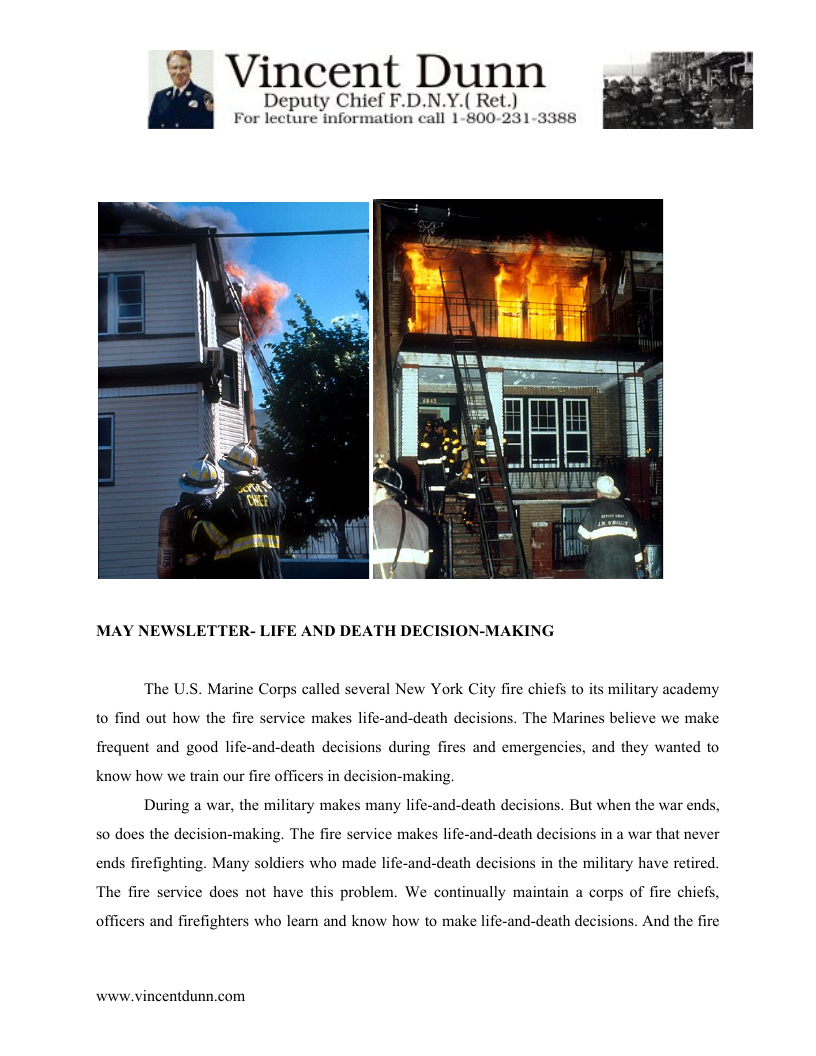
The U.S. Marine Corps called several New York City fire chiefs to its military academy to find out how the fire service makes life-and-death decisions. The Marines believe we make frequent and good life-and-death decisions during fires and emergencies, and they wanted to know how we train our fire officers in decision-making. During a war, the military makes many life-and-death decisions. But when the war ends, so does the decision-making. The fire service makes life-and-death decisions in a war that never ends firefighting.
Locating Fire PDF preview02
Training minute15 minute read

Locating Fire

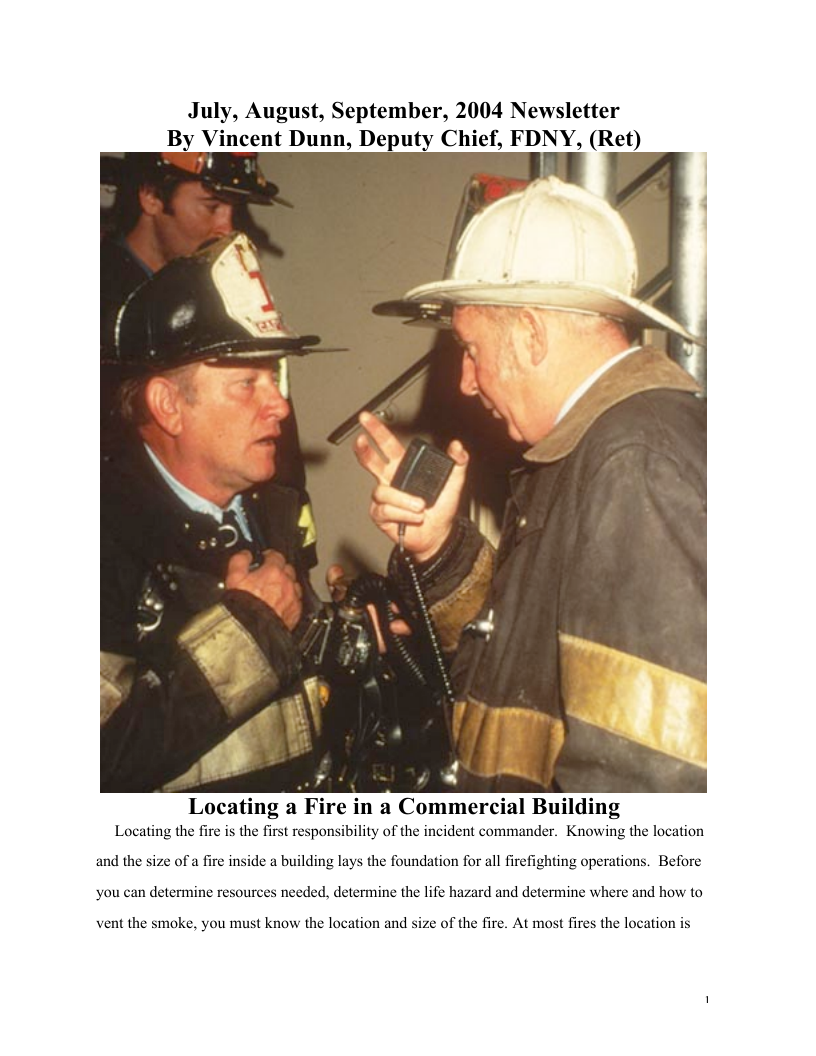
July, August, September, 2004 Newsletter Locating a Fire in a Commercial Building Locating the fire is the first responsibility of the incident commander. Knowing the location and the size of a fire inside a building lays the foundation for all firefighting operations. Before you can determine resources needed, determine the life hazard and determine where and how to vent the smoke, you must know the location and size of the fire. At most fires the location is obvious and easily determined. You see the smoke and flame. At other fires it is not.

Fireground Communications PDF preview03
Training minute5 minute read

Fireground Communications

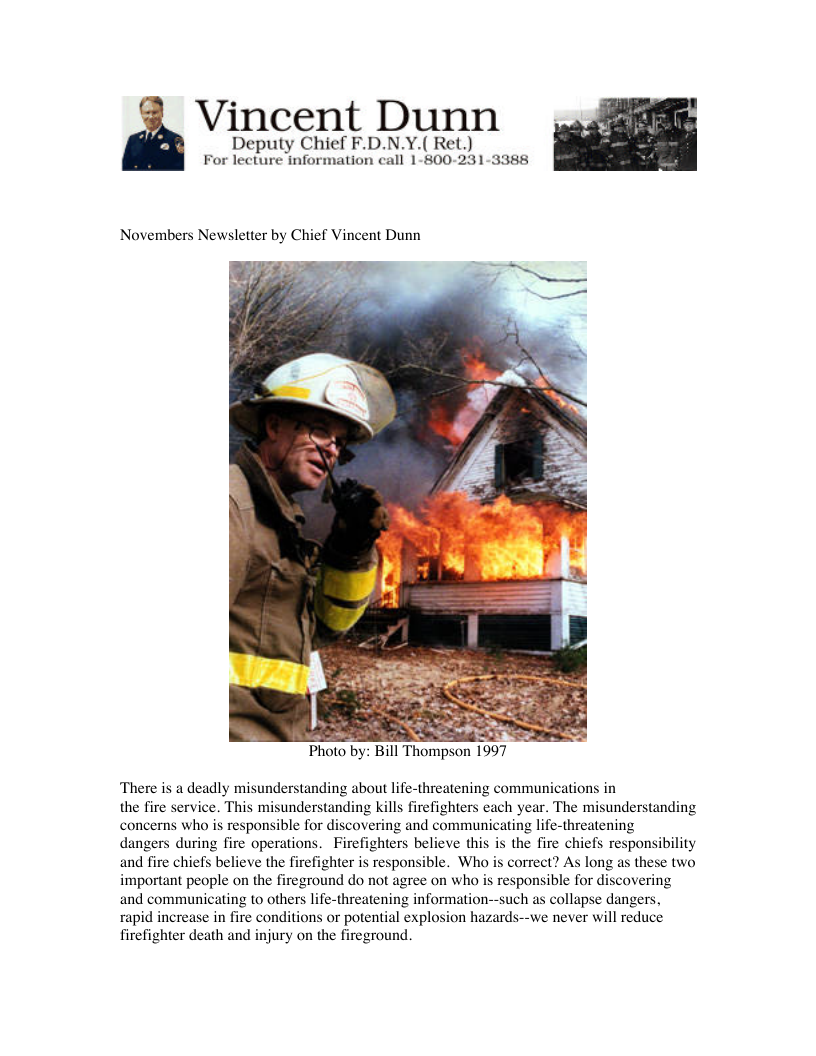
Novembers Newsletter by Chief Vincent Dunn There is a deadly misunderstanding about life-threatening communications in the fire service. This misunderstanding kills firefighters each year. The misunderstanding concerns who is responsible for discovering and communicating life-threatening dangers during fire operations. Firefighters believe this is the fire chiefs responsibility and fire chiefs believe the firefighter is responsible. Who is correct?

Structural Fire Spread PDF preview04
Training minute11 minute read

Structural Fire Spread

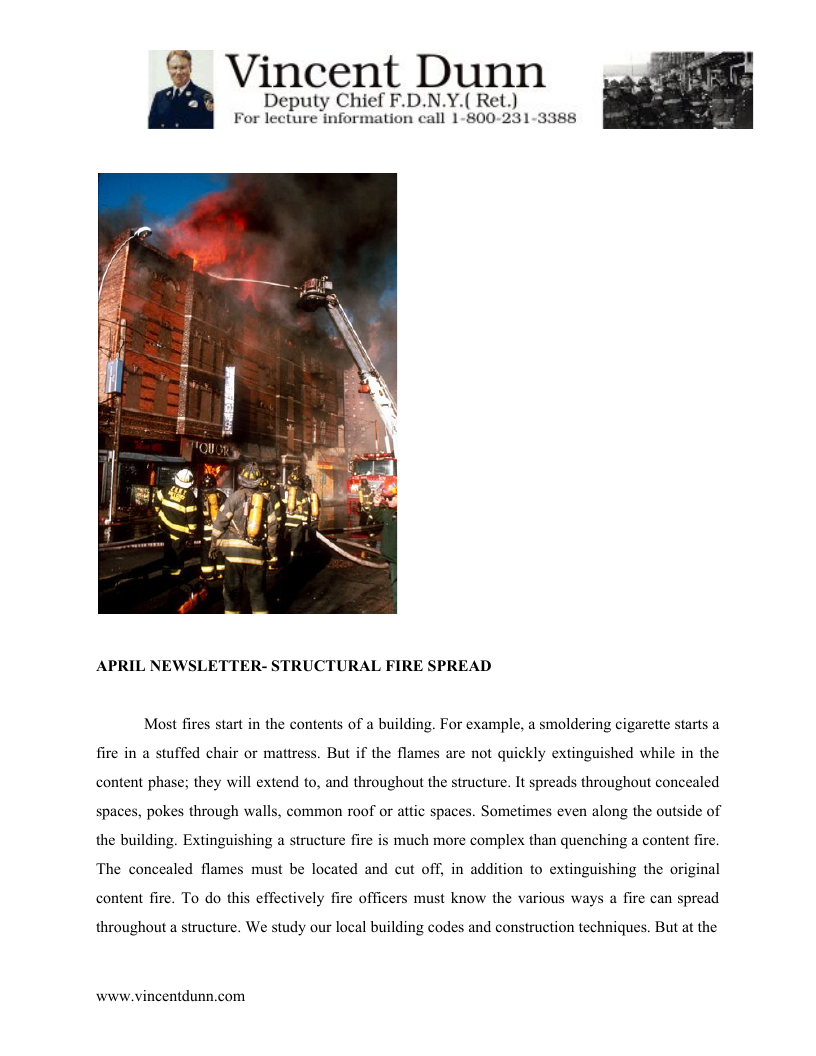
Most fires start in the contents of a building. For example, a smoldering cigarette starts a fire in a stuffed chair or mattress. But if the flames are not quickly extinguished while in the content phase; they will extend to, and throughout the structure. It spreads throughout concealed spaces, pokes through walls, common roof or attic spaces. Sometimes even along the outside of the building. Extinguishing a structure fire is much more complex than quenching a content fire.

Three Story Frame PDF preview05
Training minute12 minute read

Three Story Frame

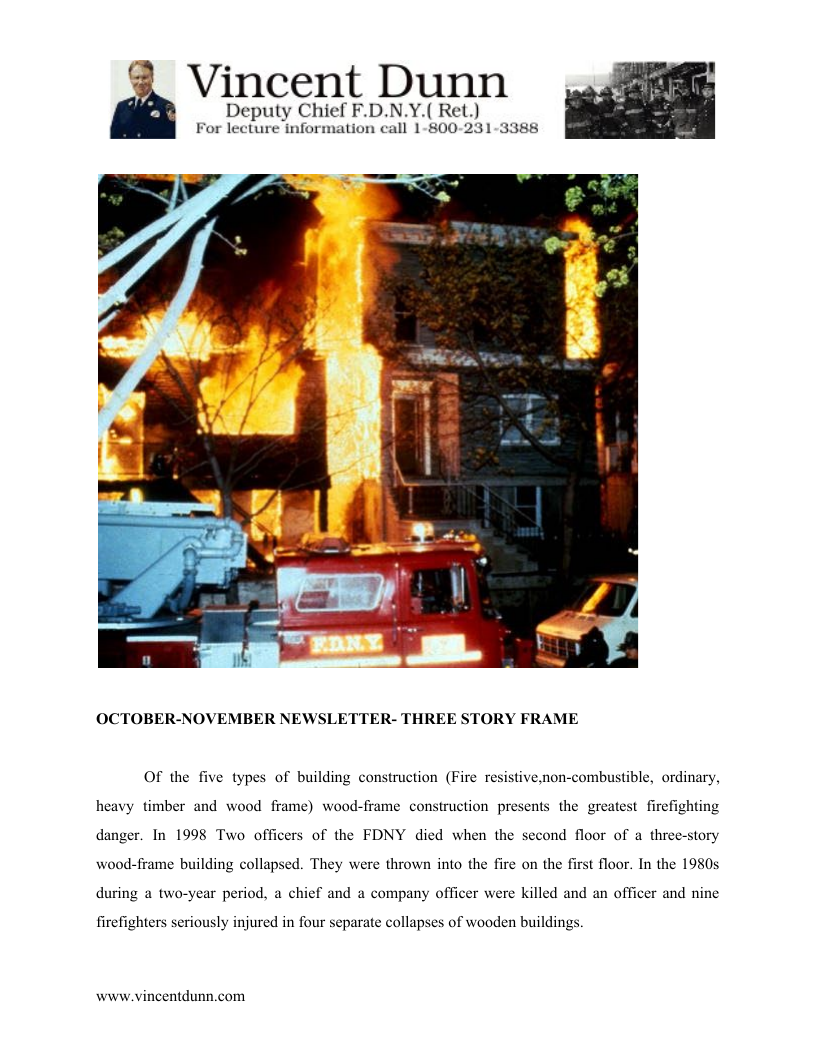
Of the five types of building construction (Fire resistive,non-combustible, ordinary, heavy timber and wood frame) wood-frame construction presents the greatest firefighting danger. In 1998 Two officers of the FDNY died when the second floor of a three-story wood-frame building collapsed. They were thrown into the fire on the first floor. In the 1980s during a two-year period, a chief and a company officer were killed and an officer and nine firefighters seriously injured in four separate collapses of wooden buildings.

High Rise Fires PDF preview06
Training minute13 minute read

High Rise Fires

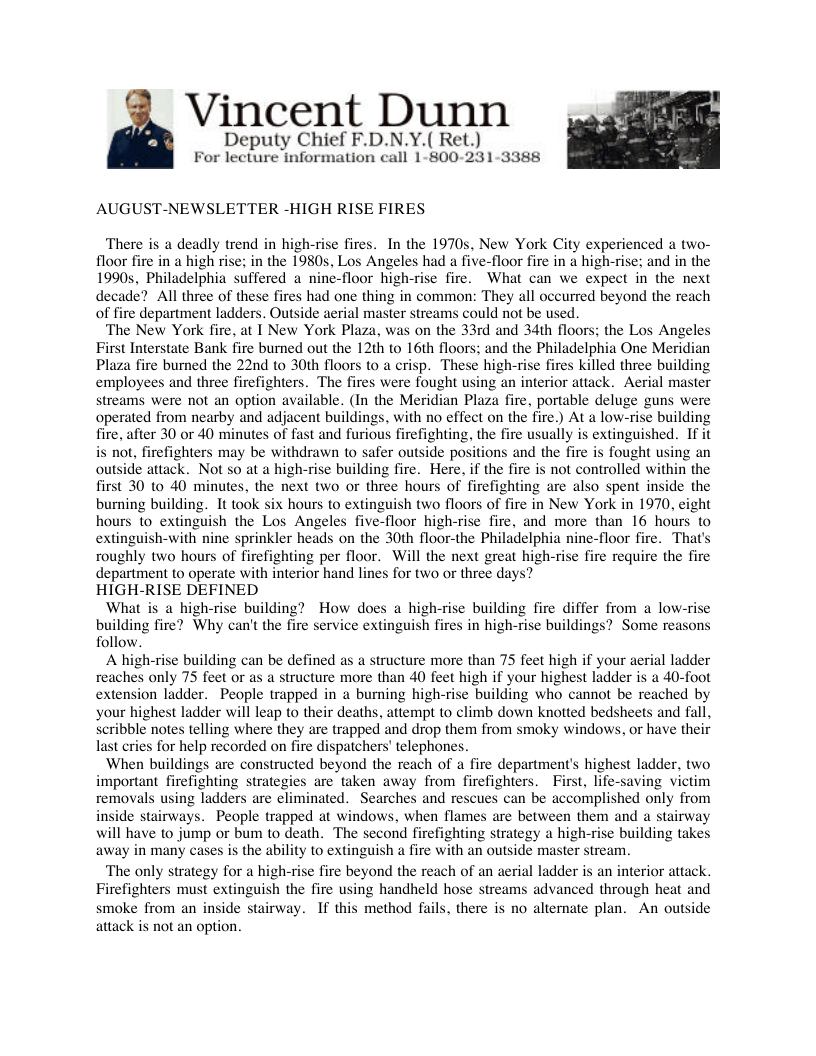
There is a deadly trend in high-rise fires. In the 1970s, New York City experienced a two- floor fire in a high rise; in the 1980s, Los Angeles had a five-floor fire in a high-rise; and in the 1990s, Philadelphia suffered a nine-floor high-rise fire. What can we expect in the next decade? All three of these fires had one thing in common: They all occurred beyond the reach of fire department ladders. Outside aerial master streams could not be used.

Elevator Dangers PDF preview07
Training minute9 minute read

Elevator Dangers

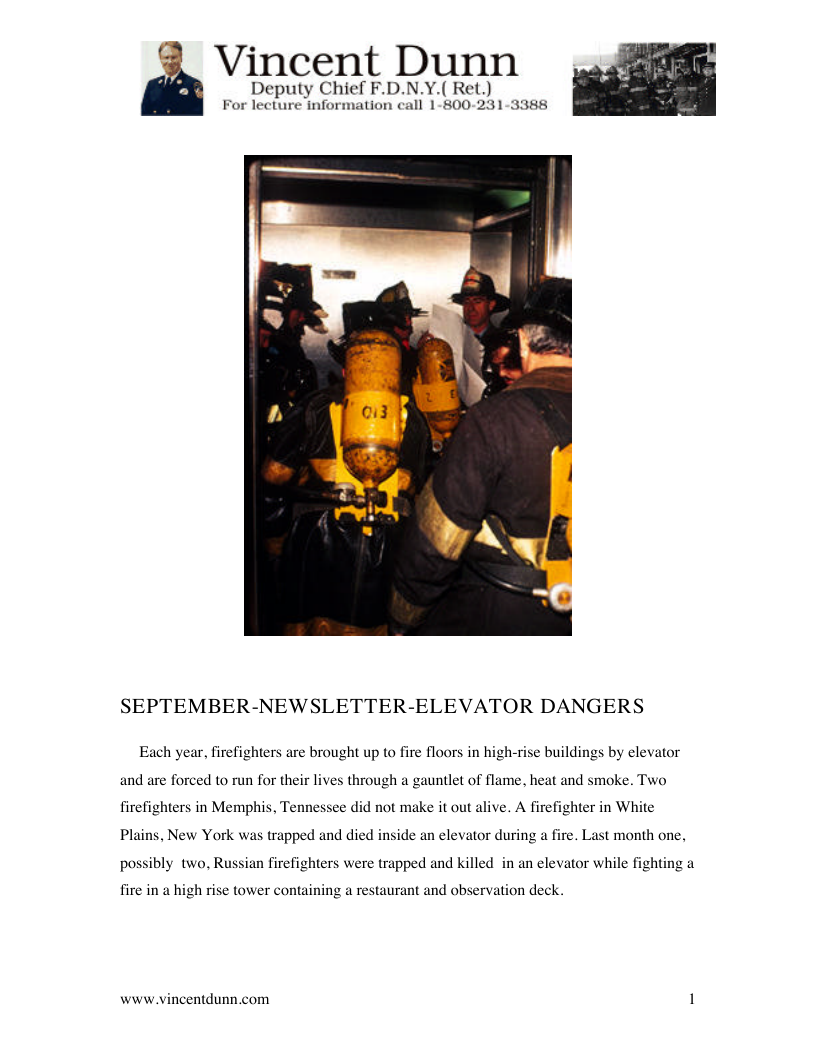
Each year, firefighters are brought up to fire floors in high-rise buildings by elevator and are forced to run for their lives through a gauntlet of flame, heat and smoke. Two firefighters in Memphis, Tennessee did not make it out alive. A firefighter in White Plains, New York was trapped and died inside an elevator during a fire. Last month one, possibly two, Russian firefighters were trapped and killed in an elevator while fighting a fire in a high rise tower containing a restaurant and observation deck.

Electricity PDF preview08
Training minute6 minute read

Electricity

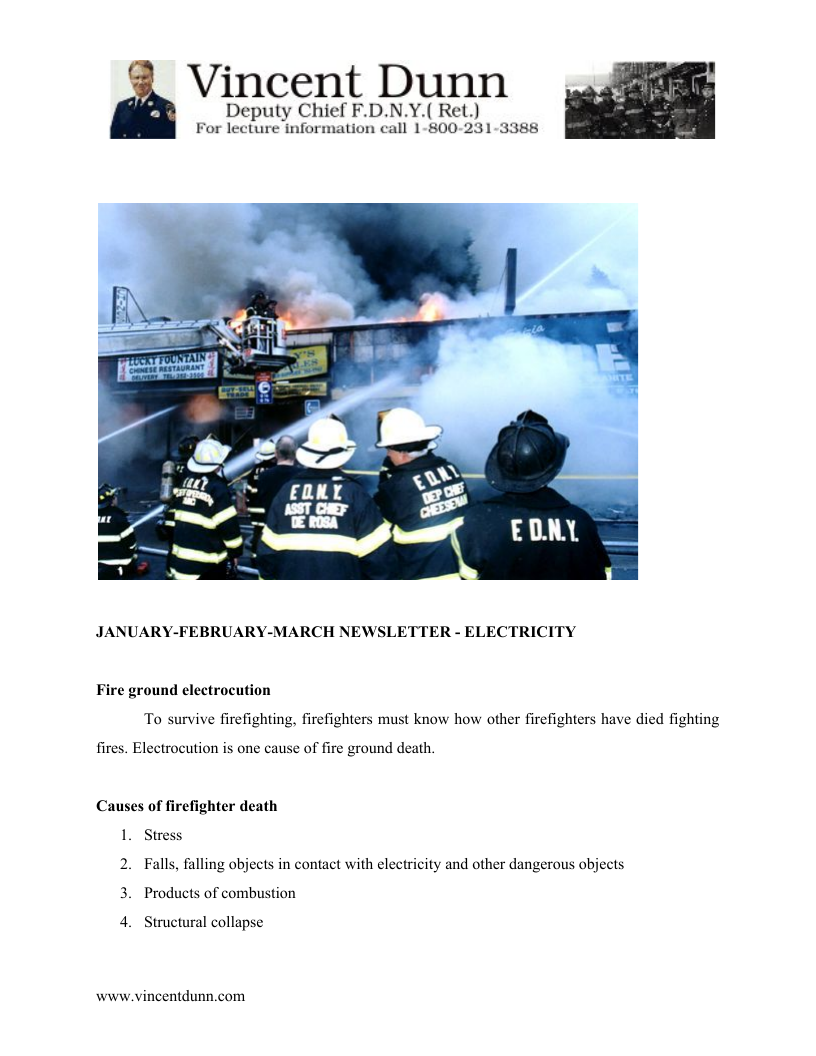
Fire ground electrocution To survive firefighting, firefighters must know how other firefighters have died fighting fires. Electrocution is one cause of fire ground death. Causes of firefighter death

Flashover PDF preview09
Training minute7 minute read

Flashover

Flashover! It is the most dangerous time of a fire. When the room bursts into flame, flashover has occurred. The scientific definition of flashover states it is caused by the radiation feedback of heat. Heat from the growing fire is absorbed into the upper walls and contents of the room, heating up the combustible gases and furnishings to their auto-ignition temperature. This buildup of heat in the room triggers flashover.

Backdraft vs. Flashover PDF preview10
Training minute7 minute read

Backdraft vs. Flashover

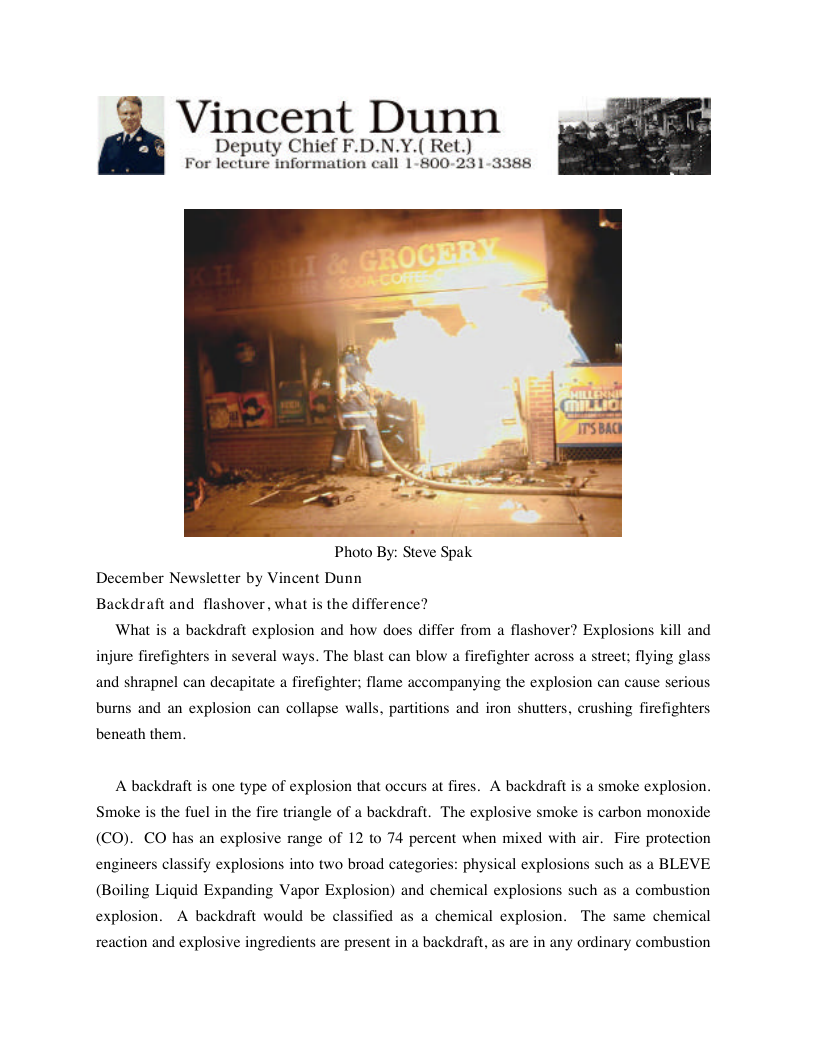
Backdraft and flashover, what is the difference? What is a backdraft explosion and how does differ from a flashover? Explosions kill and injure firefighters in several ways. The blast can blow a firefighter across a street; flying glass and shrapnel can decapitate a firefighter; flame accompanying the explosion can cause serious burns and an explosion can collapse walls, partitions and iron shutters, crushing firefighters beneath them. A backdraft is one type of explosion that occurs at fires. A backdraft is a smoke explosion.

Fire and Explosions PDF preview11
Training minute10 minute read

Fire and Explosions

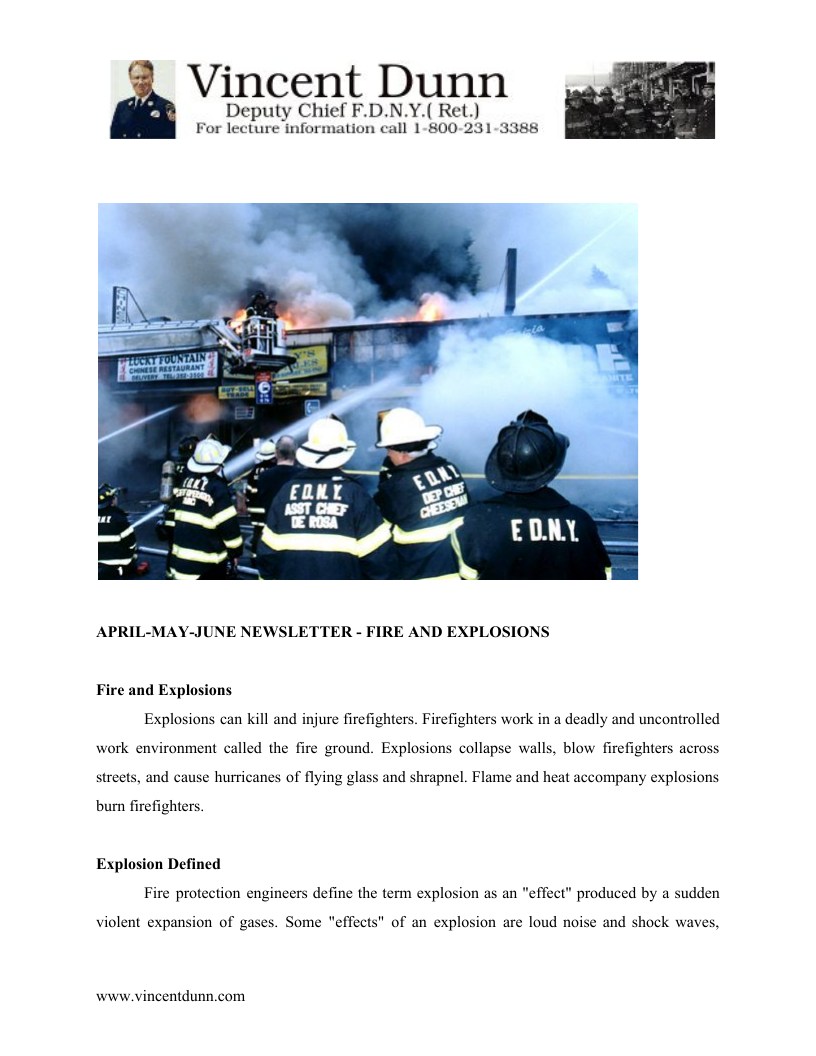
Explosions can kill and injure firefighters. Firefighters work in a deadly and uncontrolled work environment called the fire ground. Explosions collapse walls, blow firefighters across streets, and cause hurricanes of flying glass and shrapnel. Flame and heat accompany explosions burn firefighters. Explosion Defined Fire protection engineers define the term explosion as an "effect" produced by a sudden violent expansion of gases. Some "effects" of an explosion are loud noise and shock waves, which can collapse walls and shatter windows.

Front Wall Collapse PDF preview12
Training minute11 minute read

Front Wall Collapse

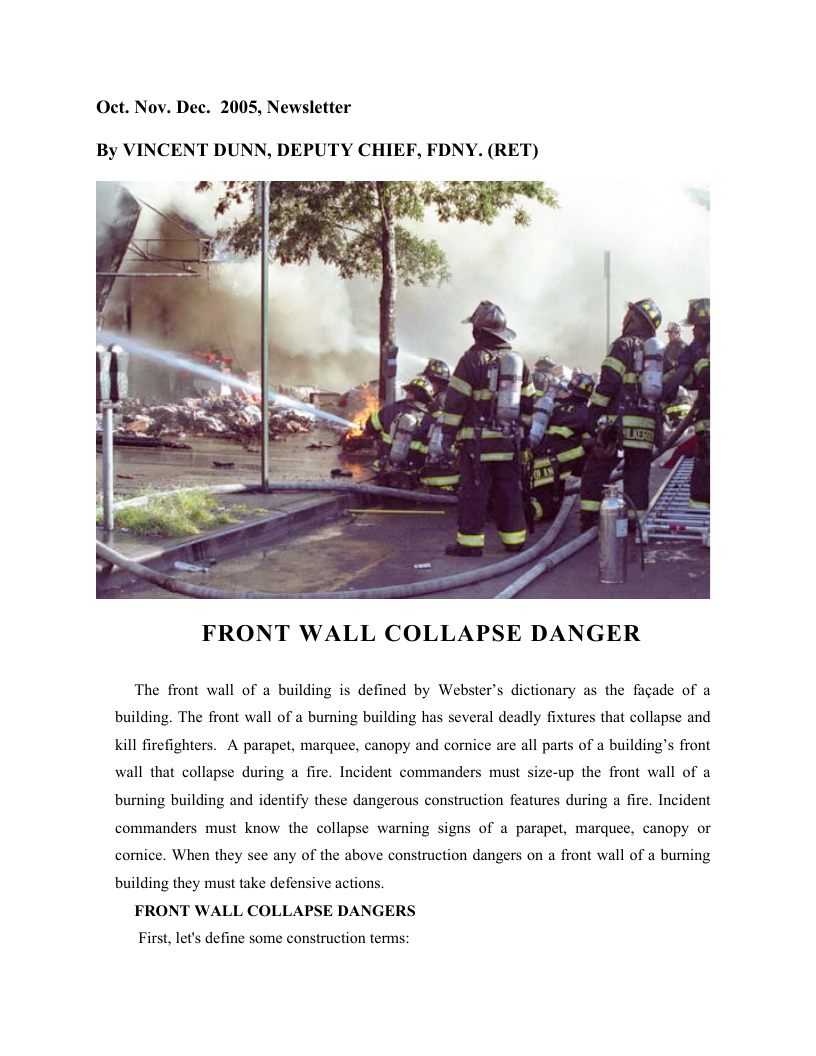
Oct. Nov. Dec. 2005, Newsletter By VINCENT DUNN, DEPUTY CHIEF, FDNY. (RET) F RONT WALL C OLLA P SE DA NGER The front wall of a building is defined by Webster's dictionary as the facade of a building. The front wall of a burning building has several deadly fixtures that collapse and kill firefighters. A parapet, marquee, canopy and cornice are all parts of a building's front wall that collapse during a fire. Incident commanders must size-up the front wall of a burning building and identify these dangerous construction features during a fire.

Masonry Wall Collapse PDF preview13
Training minute8 minute read

Masonry Wall Collapse

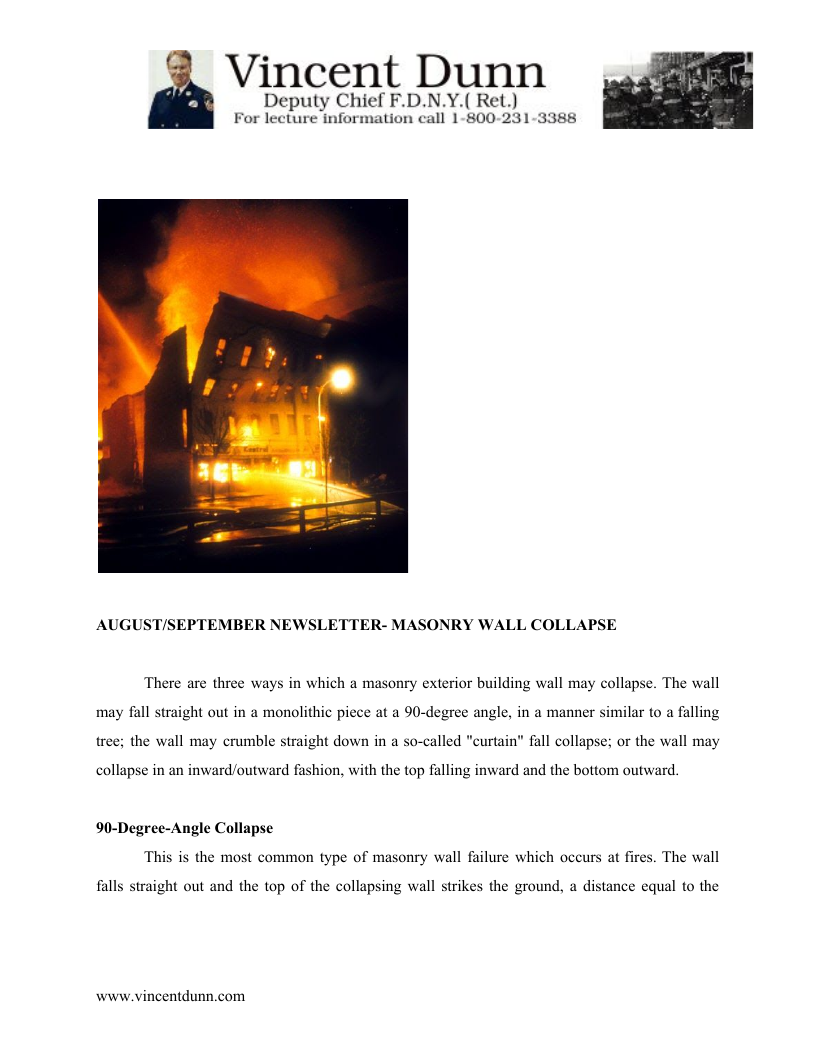
There are three ways in which a masonry exterior building wall may collapse. The wall may fall straight out in a monolithic piece at a 90-degree angle, in a manner similar to a falling tree; the wall may crumble straight down in a so-called "curtain" fall collapse; or the wall may collapse in an inward/outward fashion, with the top falling inward and the bottom outward. 90-Degree-Angle Collapse This is the most common type of masonry wall failure which occurs at fires.

Firefighters Caught and Trapped PDF preview14
Training minute14 minute read

Firefighters Caught and Trapped

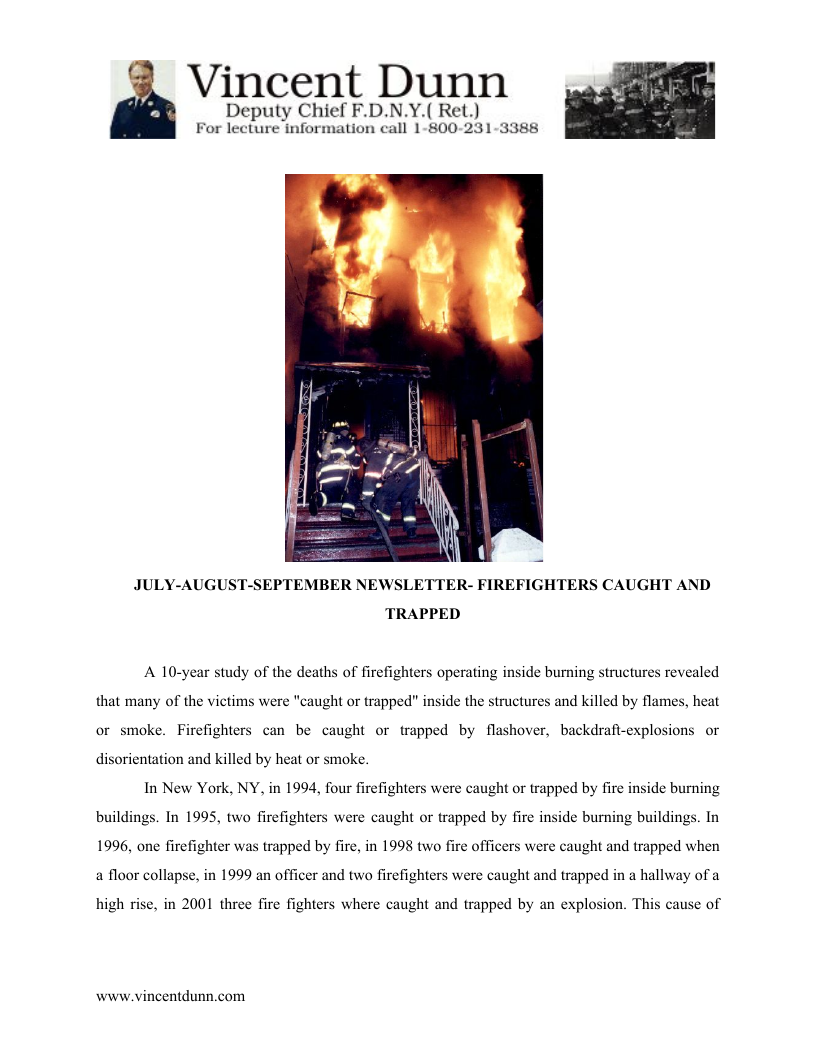
JULY-AUGUST-SEPTEMBER NEWSLETTER: FIREFIGHTERS CAUGHT AND TRAPPED A 10-year study of the deaths of firefighters operating inside burning structures revealed that many of the victims were "caught or trapped" inside the structures and killed by flames, heat or smoke. Firefighters can be caught or trapped by flashover, backdraft-explosions or disorientation and killed by heat or smoke. In New York, NY, in 1994, four firefighters were caught or trapped by fire inside burning buildings.

Collapse Search and Rescue Plan PDF preview15
Training minute8 minute read

Collapse Search and Rescue Plan

I get nauseous when I see on television a news reporter or the city manager tell the fire chief "Your department's response to fires is down. The firefighters are not working as hard as they did in the1970's and 80's". I get even sicker when the silent fire chief does not correct this misconception. When will the fire service wake up. The service we provide to the people has changed. We do more than fight fires. Very few officials in government, the news media, and in the fire service realized this. If they do, they are not saying it.

Evacuating People from Burning Buildings PDF preview16
Training minute7 minute read

Evacuating People from Burning Buildings

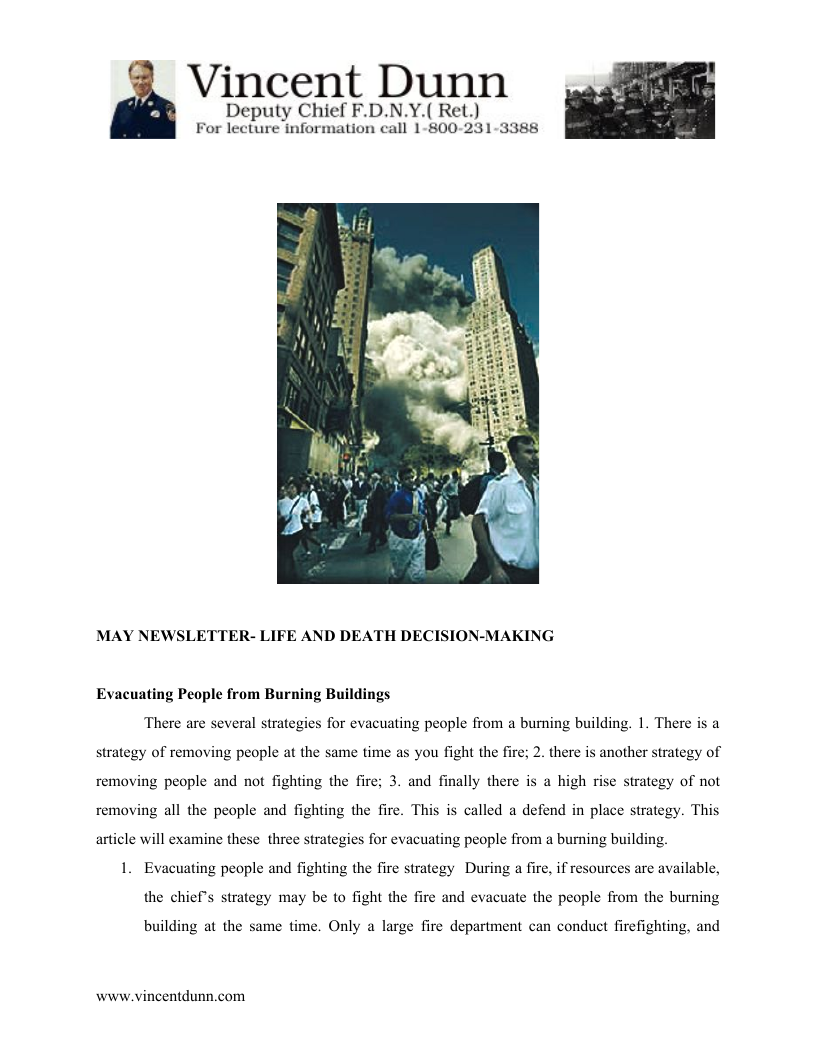
MAY NEWSLETTER: LIFE AND DEATH DECISION-MAKING Evacuating People from Burning Buildings There are several strategies for evacuating people from a burning building. 1. There is a strategy of removing people at the same time as you fight the fire; 2. There is another strategy of removing people and not fighting the fire; 3. And finally there is a high rise strategy of not removing all the people and fighting the fire. This is called a defend in place strategy. This article will examine these three strategies for evacuating people from a burning building.

Fire Escapes and Firefighters PDF preview17
Training minute14 minute read

Fire Escapes and Firefighters

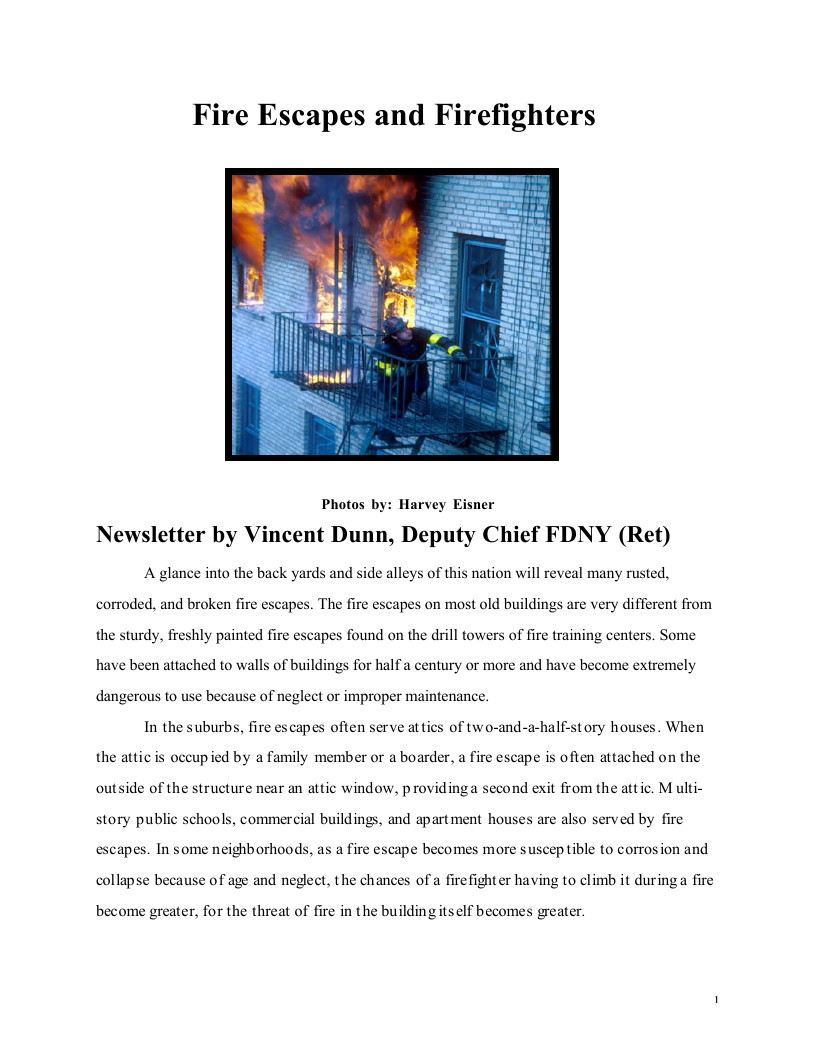
A glance into the back yards and side alleys of this nation will reveal many rusted, corroded, and broken fire escapes. The fire escapes on most old buildings are very different from the sturdy, freshly painted fire escapes found on the drill towers of fire training centers. Some have been attached to walls of buildings for half a century or more and have become extremely dangerous to use because of neglect or improper maintenance. In the s uburbs, fire es capes often ser ve at tics of tw o-and-a-half-st ory houses .

Guidelines for Stretching Hoseline at Structural Fires PDF preview18
Training minute14 minute read

Guidelines for Stretching Hoseline at Structural Fires

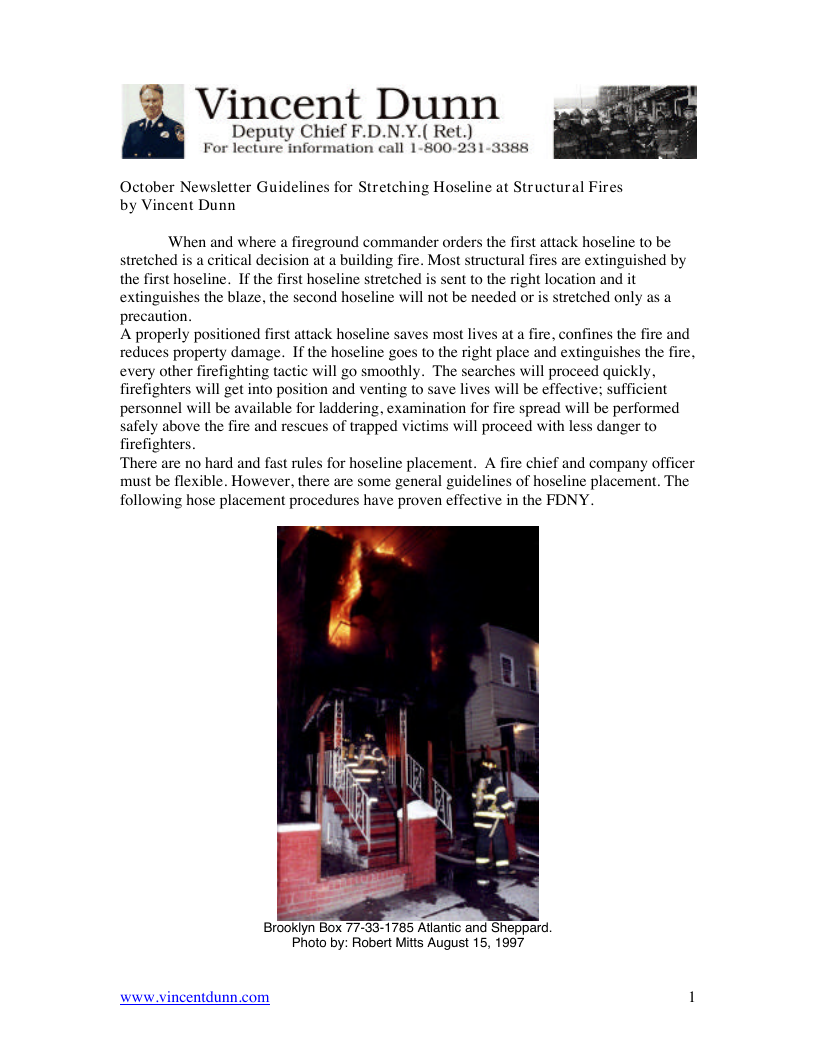
By Vincent Dunn When and where a fireground commander orders the first attack hoseline to be stretched is a critical decision at a building fire. Most structural fires are extinguished by the first hoseline. If the first hoseline stretched is sent to the right location and it extinguishes the blaze, the second hoseline will not be needed or is stretched only as a precaution. A properly positioned first attack hoseline saves most lives at a fire, confines the fire and reduces property damage.

Advancing the Initial Attack Hoseline PDF preview19
Training minute6 minute read

Advancing the Initial Attack Hoseline

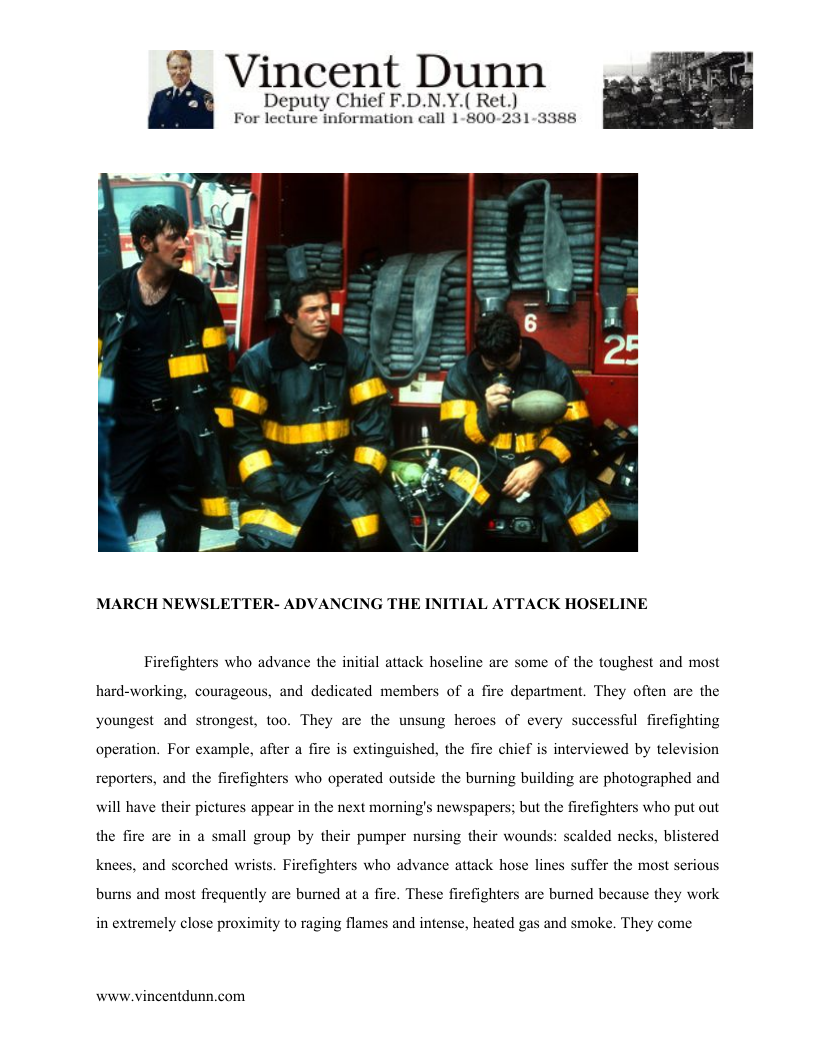
Firefighters who advance the initial attack hoseline are some of the toughest and most hard-working, courageous, and dedicated members of a fire department. They often are the youngest and strongest, too. They are the unsung heroes of every successful firefighting operation.

Brush and Woodland Fires PDF preview20
Training minute12 minute read

Brush and Woodland Fires

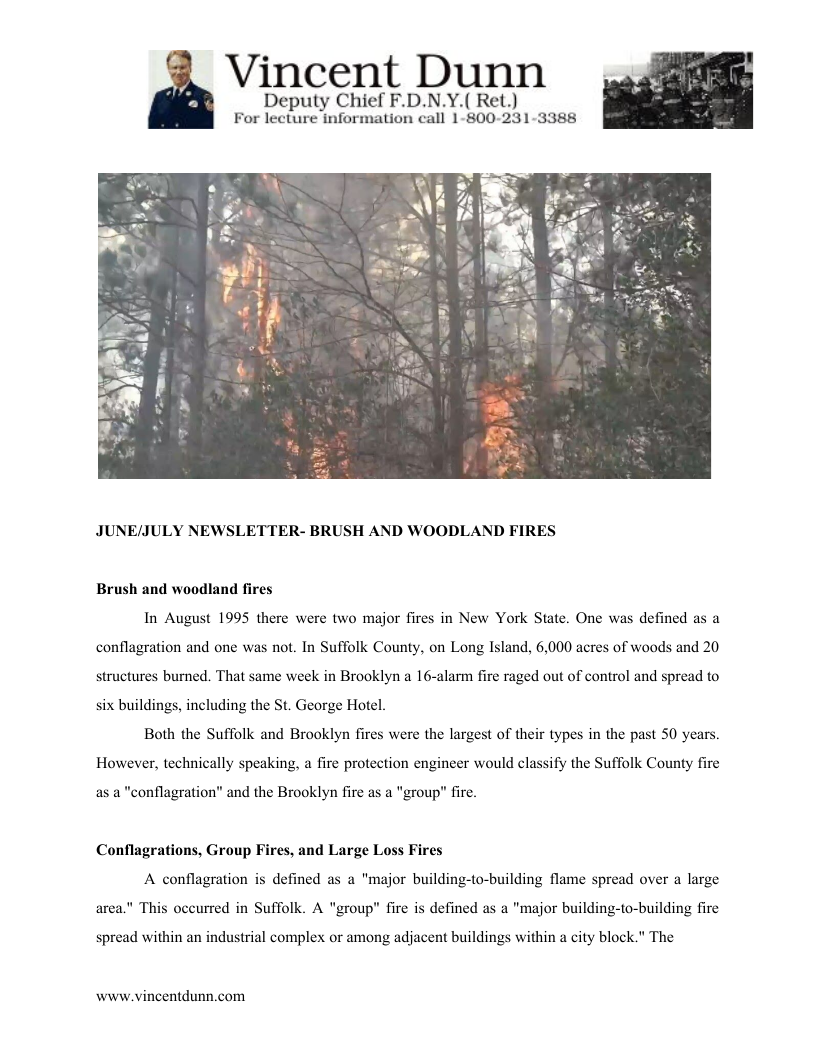
In August 1995 there were two major fires in New York State. One was defined as a conflagration and one was not. In Suffolk County, on Long Island, 6,000 acres of woods and 20 structures burned. That same week in Brooklyn a 16-alarm fire raged out of control and spread to six buildings, including the St. George Hotel. Both the Suffolk and Brooklyn fires were the largest of their types in the past 50 years.

Terrorist's Bomb Searching PDF preview21
Training minute10 minute read

Terrorist's Bomb Searching

Dear Chief Dunn, I am a firefighter in Wisconsin. Recently we had an awareness class in incident response to terrorist bombings.....Our fire department has firefighters searching for suspicious packages or bombs. Should untrained firefighters be looking for bombs? Should we even be in that building if there are no employees and the public left the building?..... I would really appreciate your views on firefighting responsibilities and guidelines at bomb threats. Thank you for your help. Firefighter, Frank X

Terrorists Bomb Explosions PDF preview22
Training minute9 minute read

Terrorists Bomb Explosions

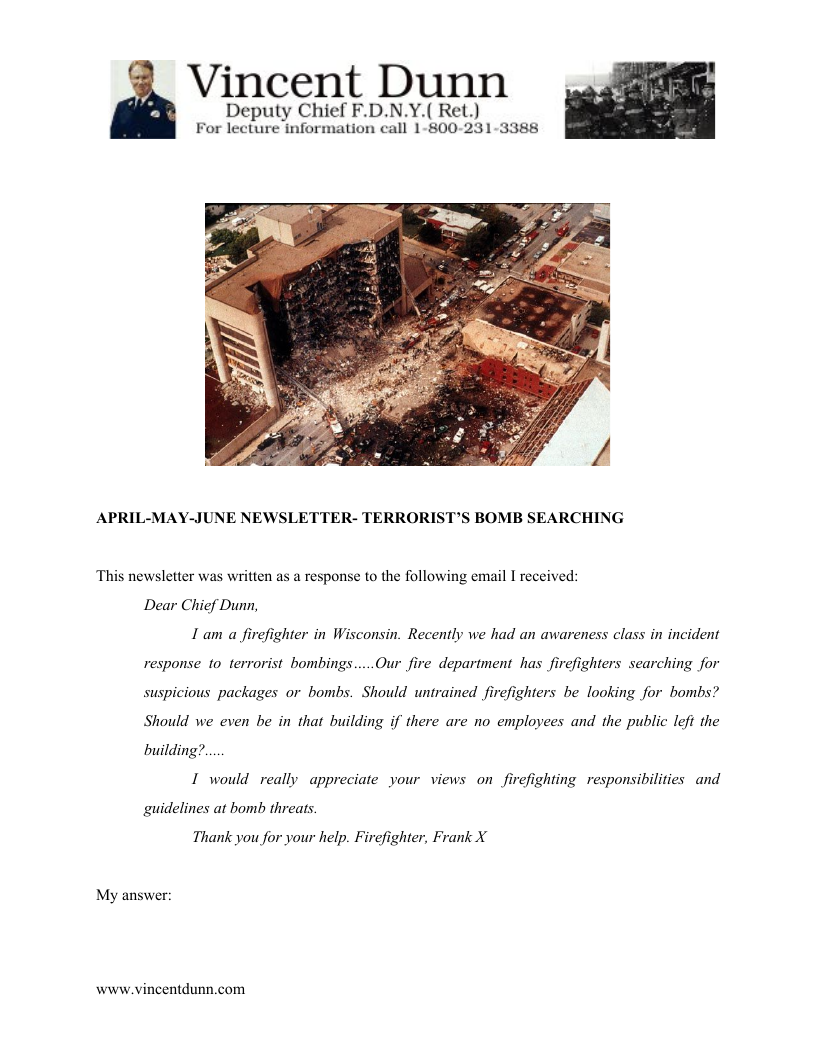
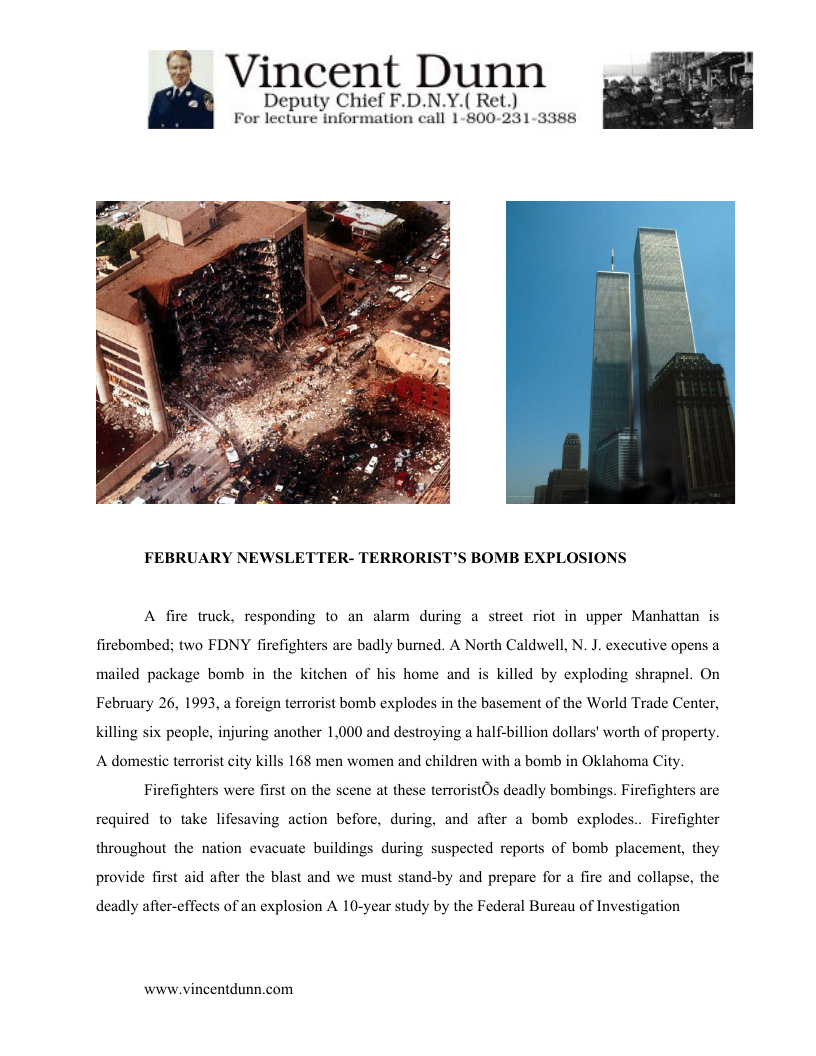
A fire truck, responding to an alarm during a street riot in upper Manhattan is firebombed; two FDNY firefighters are badly burned. A North Caldwell, N. J. executive opens a mailed package bomb in the kitchen of his home and is killed by exploding shrapnel. On February 26, 1993, a foreign terrorist bomb explodes in the basement of the World Trade Center, killing six people, injuring another 1,000 and destroying a half-billion dollars' worth of property. A domestic terrorist killed 168 men, women, and children with a bomb in Oklahoma City.

Overhaul Operations PDF preview23
Training minute17 minute read

Overhaul Operations

April, May, June 2004 Newsletter Salvage and Overhaul Operations After a fire has been extinguished and the cause-and-origin investigation completed, firefighters regroup at A the point of fire origin for salvage and overhaul duties. The officer must control and organize the salvage and overhauling operation. The hose stream is temporarily withdrawn and the proper tools are brought to the work area. Salvage and overhauling should begin at the room of fire origin and work outward. Firefighters should be assigned specific areas to overhaul.

Fire Rekindle PDF preview24
Training minute14 minute read

Fire Rekindle

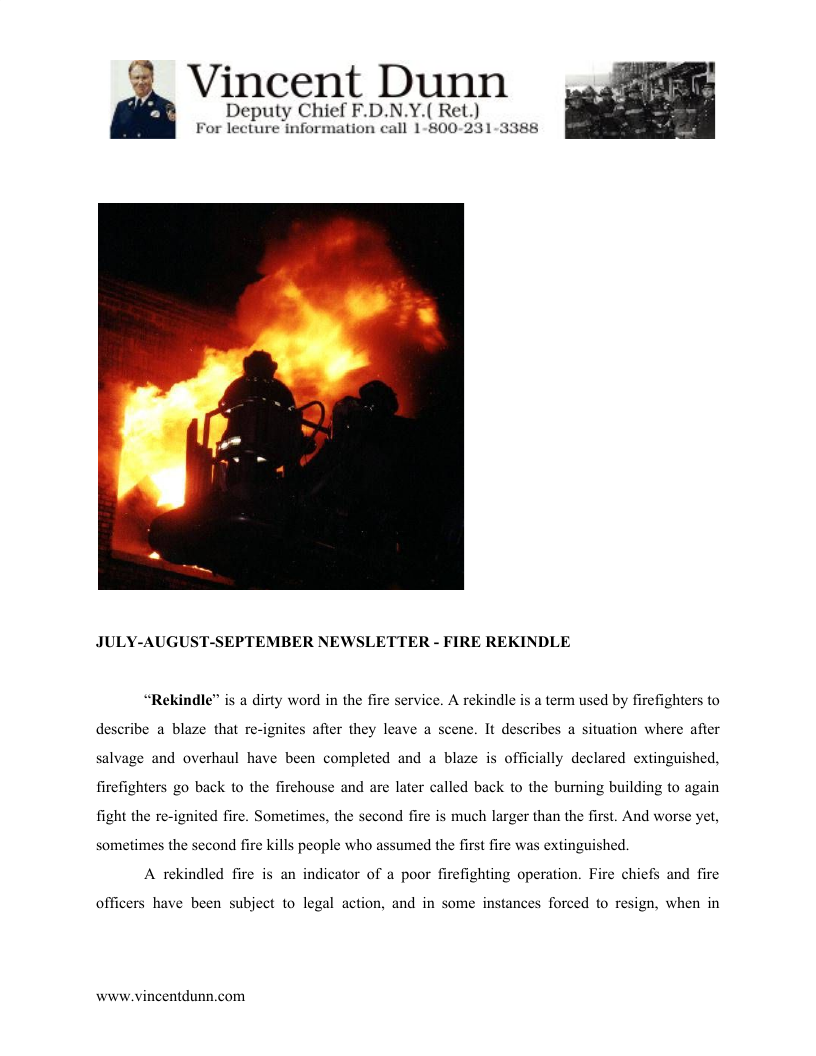
"Rekindle" is a dirty word in the fire service. A rekindle is a term used by firefighters to describe a blaze that re-ignites after they leave a scene. It describes a situation where after salvage and overhaul have been completed and a blaze is officially declared extinguished, firefighters go back to the firehouse and are later called back to the burning building to again fight the re-ignited fire. Sometimes, the second fire is much larger than the first. And worse yet, sometimes the second fire kills people who assumed the first fire was extinguished.