
Dave Dodson taught us how to read smoke; we must learn to read fire too.
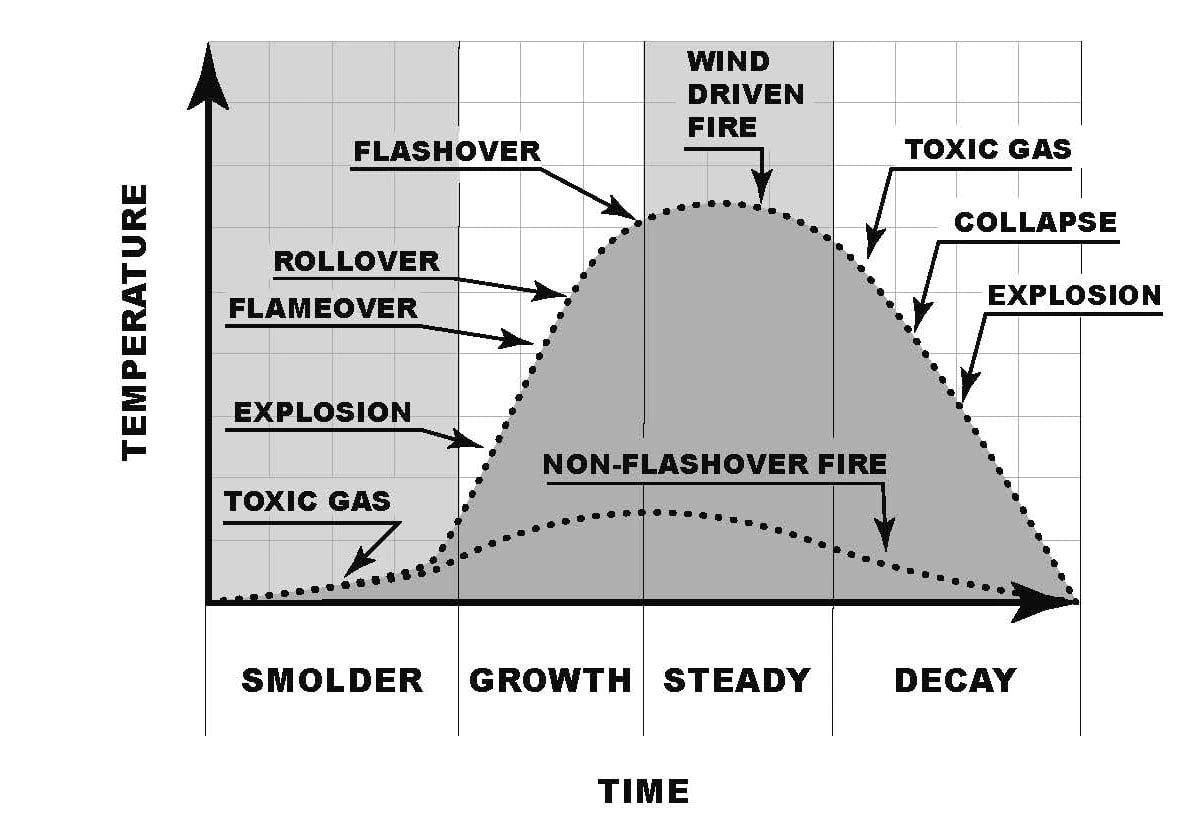
When sizing up fire on arrival, you must be able to identify its potential dangers at any time during its growth. Your life depends on being able to read the stages of fire growth and the danger each stage presents. Fire’s danger differ at each stage of fire growth. The dangers never end; they exist even after extinguishment.
But there are degrees of danger Firefighters must know and interpret in order to survive. We must understand and predict what’s going on at a glance. Fire dangers may be minor, then increase or stay the same and then decrease. Firefighters must know when fire dangers are increasing, staying the same or decreasing.
Of the four stages of fire – smoldering, growth, steady burning, and decay — it is the second or growth stage of fire that is the most dangerous because of its volatility. This second, or growth stage, has many potential killers — flashover, rollover, flameover, smoke, heat and explosion — growing with the flames, ready to strike at any time. In the volatile growth stage, conditions change suddenly. The second or growth stage has the most deadly, sudden surprises awaiting unsuspecting Firefighters.
For example, the first smoldering stage is the least hazardous. The fully developed fire in the third stage, may look bad with all the flame and heat, but it is not as bad as the unpredictable growth stage before it. The growth stage is not steady; it is volatile and can change for the worse instantly. In the third, steady flaming stage, “what you see is what you get” — no surprises. You are warned by all the flame and heat and this rightfully should make you cautious and ready for firefighting.
The last stage of fire — the decay period — is deceptive. After extinguishment, the flame and heat have subsided and you have survived. Conditions do not look as threatening. This can be a mistake. To read a fire correctly, you must know the fire dangers waiting for you from beginning to end.
Short words and phrases are used by Firefighters to describe the four stages of fire:
“Misjudged” or “underrated” explain the first smoldering stage; “shock” or “surprise” describe the second growth stage; “inferno” and “major blaze” tell us about the third stage of fire; and “deception” and “deceit” express the last decay stage of a fire.
The second or growth stage of fire is the most dangerous because of its volatility. This second or growth stage has many potential killers — flashover, rollover, flameover, toxic smoke, heat and explosion — growing with the flames, ready to strike at any time.