
DO YOU KNOW WHERE THE FIRST THREE HOSELINES ARE STRETCHED TO AT A HIGH-RISE OFFICE BUILDING FIRE?
IF YOU DON’T KNOW WHERE THE FIRST THREE HOSELINES GO AT A HIGH-RISE OFFICE BUILDING FIRE, YOU BETTER READ THIS POST.
A commercial office high-rise building is different from a high-rise residence building and this affects firefighting strategy.
First of all, a commercial high-rise is a sealed glass building with locked windows; it has a design of 10,000 or 20,000 sq. ft of open floor space allowing fire to grow beyond the 2500 sq. ft. extinguishment capability of a typical hose stream; it has central air systems with ducts connecting 5 or 10 floors with ducts that spread smoke requiring the heating venting and air conditioning (HVAC) system to be shut off, and finally, venting window is not an option as it can trigger uncontrollable and fire flow paths across the large open floor areas.
Conversely, a high-rise residence building has windows designed to be opened that can be vented; floors are subdivided with partition walls, confining fire size; apartments have individual unit air conditioners without connecting ducts and wind-driven fire can be controlled by closing the apartment door.
The following is a firefighting action plan for a commercial high-rise building.
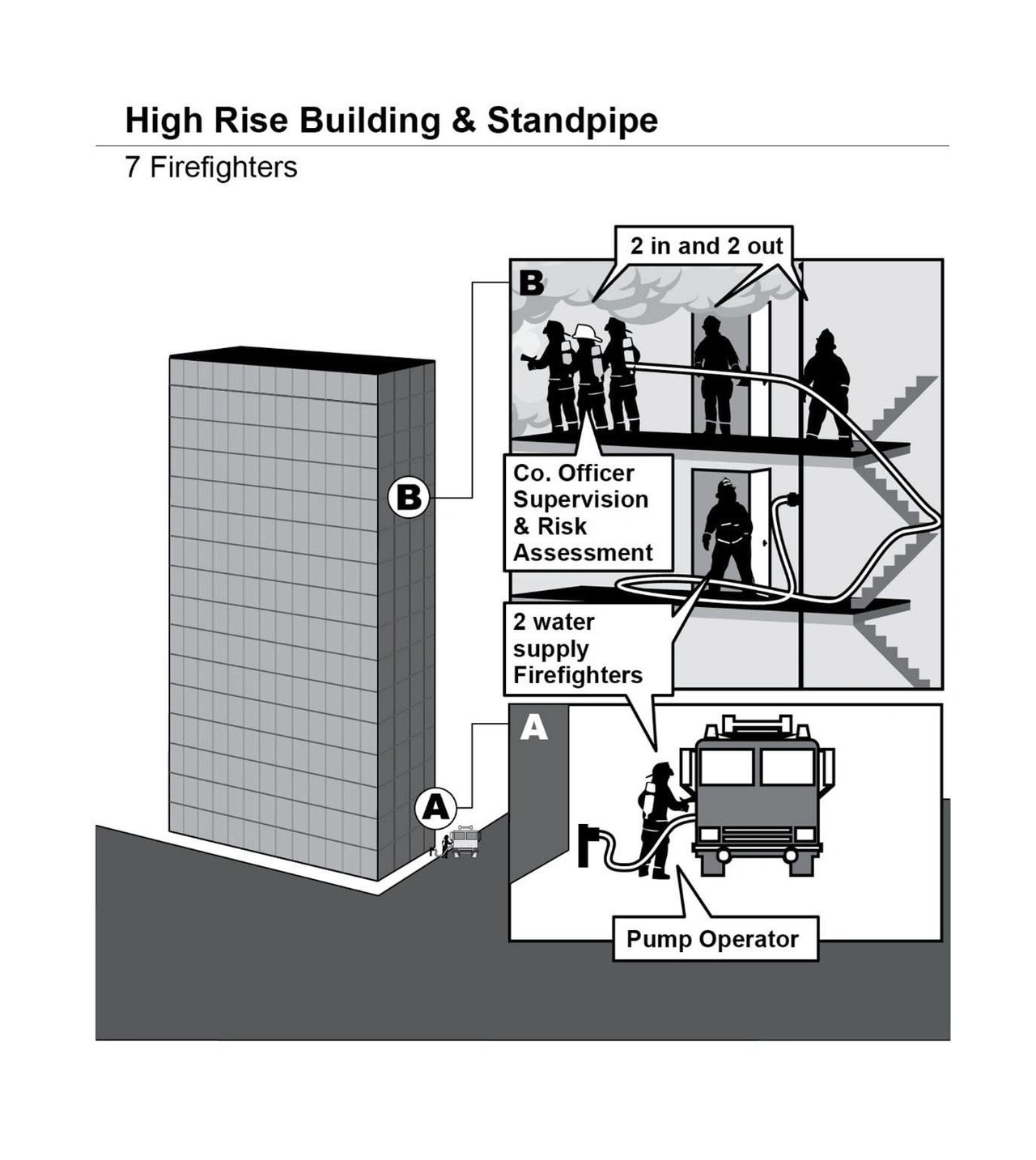
Destination of first attack hoseline: The first hoseline at a high-rise office building fire is four lengths of the largest hose available (2½ inch diameter) folded and carried up in an elevator, taken off two or more floors below the fire, walked up to the floor below the fire, connected to the standpipe outlet, stretched up the stair, charged with water, advanced in the smoke filled fire floor, and fire extinguished using a solid bore nozzle or solid stream of a fog nozzle.
Justification: large diameter hose is required because office floor areas are large and without partitions, so big fires develop. It is urgent to get hose up to attack the fire before elevators fail, which they often do because of fire, heat and run off water. Firefighters take elevators to floors below the fire because the initial incorrect report of the fire floor could be given by someone on the floor above the fire seeing smoke rising from below.
Connect hose to the standpipe outlet on the floor below the fire because a wind driven fire can drive you back into the stair enclosure for refuge and burn the hose if it is connected on the fire floor. Use a solid bore nozzle or solid stream of a fog nozzle because fog requires venting and this may not be possible at a high-rise. Four lengths are used because you do not want to “stretch short” of the fire on these large floor areas.
Second attack hoseline: The second attack hoseline of four lengths and a solid bore nozzle is brought up in an elevator and connected to the standpipe outlet two floors below the fire or, if fire has been knocked down, this second back up hose can be connected to the outlet on the fire floor level. A second hoseline is automatically a back-up line unless there is fire discovered on the floor above.
Justification: An office building floor occupancy, unlike a residence high rise, has large open floor areas that can develop a large body of fire requiring two hose teams operating side by side for extinguishment. Getting the first and second hoselines flowing water is the key to successful high-rise office building firefighting. If you do this you will be successful, but it is easier said than done. At a high-rise office building fire during work hours, there will be an large number of urgent requests for firefighter assistance but an incident commander must focus on getting these two lines in operation. Hose streams save more lives than other actions — water stops the generation of deadly flame, heat and toxic smoke that kill people. There have been high-rise fire disasters where the calls for assistance overwhelmed resources at the scene and hoselines were never stretched to the fire with tragic consequences. The priorities of firefighting are life safety, before fire containment, but at high-rise fires an incident commander must focus on getting the wet stuff on the red stuff. Life-or-death decision-making sometimes requires ignoring life safety for a few, to ensure life safety for many.
Third attack hoseline: A third attack hoseline will be connected to the outlet on the fire floor and taken to operate on the floor above the fire to quench any fire extension as the first two hoselines continue to operate in the fire floor of origin. In some instances a third line may be used in a flanking attack when wind prevents advancement of the first two hose teams.
Justification: It takes two hoselines to extinguish a fire on a large commercial high-rise floor. It is rare that a third line is required. Two hose team may remain on the fire floor for long periods while a controlled burn consumes all furnishings on the fire floor. It the opportunity exists for a flanking attack, the second hose may be repositioned for this, or the third hoseline will be advanced in a flanking position.