
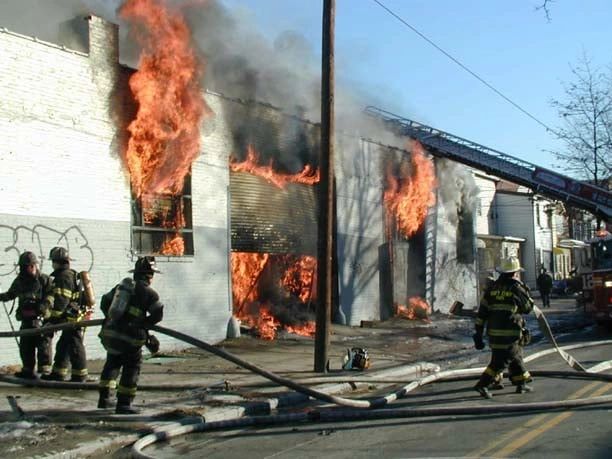
IF YOU DON’T KNOW WHERE TO STRETCH THE FIRST THREE HOSE LINES AT A FIRE IN A TYPE II NONCOMBUSTIBLE WAREHOUSE YOU BETTER READ THIS POST.
There is a deadly battlespace challenge in a type II warehouse fire: The steel bar joist roof! The Fire Protection Handbook (NFPA), National Fire Protection Association, 20th editions, volume II, pages 19-50 has been telling the fire service for 50 years, “an unprotected steel bar joist can fail after five to 10 minutes of fire exposure”. This steel bar joist construction beam is deadly. It was used for floor construction in the world trade center towers that collapsed in seconds. It’s cheap, that’s why the construction industry likes it; but is deadly that’s why the fire service hates it. Early roof collapse danger is the big warning from the NFPA. Another challenge in a noncombustible warehouse is its content fuel load. A noncombustible type II warehouse is designed for low hazard content storage, not high hazard storage. What you store in warehouse is very important. We know it has early roof steel bar joist failure so if you add high hazard content into this building it must be protected by an automatic sprinkler. “It’s the content stupid, not the building”! that is what any firefighter will tell you when evaluating a buildings fire hazard. It is a firefighters way of saying a building’s content fuel load is more important than it structure fuel load. These two hazards must be considered when evaluating the dangers of a type II, warehouse fire and where to stretch hose lines, they are: the collapse danger of the steel bar joist and the fire hazard of the content stored inside. The content storage fire hazard was tragically demonstrated at two deadly fires: The South Carolina Sofa Super furniture store where nine firefighters died in a concrete block and metal bar joist structure in 2007, (NIOSH Firefighter Fatality Investigation 2007-18); and before that, at a fire in Brackenridge PA wood furniture refinishing factory, in 1991 where four firefighters died in a masonry and steel structure. Collapse of unprotected steel was not a primary cause of death in the Sofa Super store but it was the primary cause in the Brackenridge Pa. wood furniture refinishing building fire. Both buildings had zero “structural” fuel load but heavy “content” fuel load. There was nothing combustible in both structures, only concrete and steel, but both buildings had high hazard content inside them. South Carolina Sofa Super store was packed with furniture, and the Brackenridge PA building houses a furniture refinishing and paint spraying business. Fire protection engineers tell us there are two concerns when surveying a buildings fire hazard: content fuel load and structure fuel load. Based on these two fires that killed a total of 13 firefighters we learned, content fuel has more impact on fire than the structure fuel. Both fires occurred in Type II, noncombustible buildings concrete and steel buildings containing high-hazard content.
Destination of first attack hose line: The first attack hose line is stretched to the fire inside the warehouse building and the blaze extinguished. It is important the firefighting crew stays together and supervisors exercise tight accountability and control. and the hose line is used as a life line in case a quick withdrawal becomes necessary. Crew integrity is important because of disorientation caused by high piled storage and rapid smoke development from burning plastic content. If the building is has a standpipe or sprinkler the first and second lines supply the these auxilary systems and the third line is taken into the building by firefighters.
Justification: Before hose stretch a search crew enters the warehouse and locates the fire. Crew continuity is critical in a warehouse fire because a large area or a high ceiling can allow flame to spread undetected over the heads of firefighters. Until the fire is located firefighters are staged outside. There have been fires where firefighters enter a large warehouse become lost and when fire is located no one is available to stretch hose. Stored material in high piles also block vision and narrow twisting passage ways can cause disorientation. Fire officers must maintain sight or radio voice contact with all firefighters in their command.
A hose line attack is still an effective strategy when fire is still in manageable proportion so a quick offensive hoseline attack is our first strategy. If a fire is allowed to grow and spread in a large area warehouse and spread outside the dangers actually increases. A large spreading fire can cause explosions, spread to nearby buildings, collapse walls roof and burn electric overhead wires.
Second attack hose line: A second hose line is stretched to back up a first hose team. This hose line can be used to assist the first hose team extinguishing a growing large fire or to cool down steel structures near the fire. A cooling hose stream can prevent steel expanding, warping, sagging and collapsing as the first hose team completes extinguishment of flaming content.
Justification: Warehouses are type II steel buildings and structure steel heated to 1000 to 1100 degrees F, can cause steel to collapse. If steel is heated to 1000 deg. F is starts to to lose load bearing capability. At this temperature, it will lose approximately half (40 percent) of its load carrying capacity. This critical temperature is not the ambient temperature of flame the steel itself must reach this temperature. Cooling with a hose stream may delay this temperature rise in steel. In an open timber wood truss roof building the second line prevents fire from spreading up to the wood roof above a content fire, in a steel bar roof of a warehouse the second line prevents heat from spreading up above a content fire.
In addition the overall objective of a second back up line is “redundancy” or a fail-safe action to :
1. To step up and take over in case the first line has a burst hose, defective nozzle, or standpipe system fails;
2. To protect firefighters on the first line in case of flash fire, collapse or explosion;
3. To help extinguishment when there is too much fire for one line; Note: If the second line is needed to be stretched to a seriously threaten nearby exposure building instead of as a back up line, a third line is stretched as back up to the first line.
Third attack hose line: A third line is stretched to the front of the building and firefighters ordered to stand fast awaiting orders.
Justification: This hose stretch and stand fast order is a proactive move to give an incident commander some time to decide the next move as a fire operations is in flux and conditions change. This line t may supply an aerial master stream in preparation for a strategy change from interior hose attack to outside defensive attack. Or a third hoseline may be taken to the roof if fire spreads to the combustible asphalt roof layers